Third Future School’s continued partnership with WFISD raises questions and concerns as organization takes on two additional schools
The partnership between WFISD and Third Future is adding two new schools in 2026 but staff and parents still have unanswered questions and concerns.


As the topic of education is shifting across the nation, quality of education is something on the minds of parents and teachers everywhere. Even students seem to be curious about what school will look like for them as they age through these changing structures. In the case of Wichita Falls, what’s causing some community concern for education is the new additions of the Wichita Falls Independent School District’s (WFISD) 1882 partnership with Third Future Schools.
While Third Future has partnered with a few districts in Texas already, they began their first partnership in the Wichita Falls district this year, beginning with Hirschi Middle School. Some of the adjustments made at Hirschi received skepticism and criticism from parents and staff very early on in the 2025-2026 school year. From concerns about students being expected to correctly answer math questions in the lunch line to avoid being sent to the back, to concerns about how the nonprofit school organization manages discipline, there were multiple significant changes that parents and staff were unsure of.
The purpose of the partnership is to attempt to bring scores at the schools up to standards. The partnership was presented to some school districts as an alternative solution by the Texas Education Agency (TEA) when they threatened involvement to address the unsatisfactory scores of the schools. The partnership gives Third Future Schools three years to turn the schools they’re responsible for around.
Though transparency on the progress of this task has been promised to the community, no update has been delivered on Hirschi, yet. However, Third Future Superintendent of Schools, Zach Craddock, shared in an interview with Dark Roast Report that he intends to begin presenting updates on these numbers at more town hall meetings during the Spring semester. As of now, he said that information is generally just shared periodically with school officials. He wants it to be clear that Third Future only partners with schools that are struggling and aren’t an established Charter school in Texas, but are a 501(c)(3) organization that isn’t prioritized with bringing in a profit.
“We do have performance goals we have to meet, and I present that information at the pleasure of the board and their superintendent,” Craddock said.
In the last few months, WFISD announced partnerships with Third Future on two other schools – Southern Hills Elementary and Booker T. Washington Elementary. Though the Third Future’s structural expectations for these schools will essentially be the same, them being elementary schools will result in some differences from how Hirschi has been transitioned so far. This detail poses even more questions for community members.
Craddock explained that grades second through eighth are referred to as “LSA” by Third Future. He described learning expectations for these ages as “traditional” with an emphasis on literacy. He said that the learning expectations advance for middle school ages. There are standard classes and then “break-out groups” for students performing above expectation. School days are longer, the school year is longer, and the primary means for discipline is suspension, proving how no-nonsense the structure is intended to be.
In a November meeting in which staff and parents were invited to ask Third Future representatives about the partnership addition of Southern Hills, a representative stated that Third Future’s structure was not intended to make school more comfortable, but more rigorous. However, Third Future doesn’t manage high schools, which raises the question of how this rigid educational structure will prepare students to transition to high schools in the area.
Along with heftier expectations for students, more is expected from teachers that work for schools managed by Third Future. In the same November meeting, representatives discussed how curriculum is provided to teachers by Third Future staff members and is expected to be taught in a particular fashion. Teachers are expected to record class lessons as they’re taught for students that aren’t in class either due to absence or disciplinary reasons. Though the school year is longer, teachers are only allowed to take nine personal days off work, according to their website. They added that teachers are regularly evaluated to ensure they meet those standards, with principals doing around ten evaluations a week. Additionally, they noted that staffing is dependent upon enrollment because with less students, they receive less funding.
In Dark Roast’s interview with Craddock, he expanded on the topic of funding, explaining that funding comes from the district but Third Future Schools distributes that funding across the campus’s costs. Part of this funding is designated to paying staff. Craddock said that when it comes to Third Future managing a school, they prefer the current staff to stay but noted that generally, ⅓ choose to leave, ⅓ want to stay but don’t meet their expectations, and ⅓ stay and meet Third Future’s requirements.
He said that Third Future’s process has always been to give first dibs on jobs to current staff members but because of their strict expectations, many teachers aren’t willing to comply. He said that when a position is not able to be filled by staff in the school, they work adamantly to fill that position to allow operations to continue to move fluidly. Craddock added that they offer better pay than other schools in the area to compensate for those high expectations though.
“Student outcome is tied to main areas – quality of instruction and leadership of a school,” Craddock stated. “We also know that turning around an underperforming school is one of the hardest jobs in education.”
One teacher from Southern Hills is among the ⅓ that are skeptical of Third Future’s process of managing students and staff and has chosen not to continue teaching for the school once Third Future is integrated in. Alison Fields is in her third year teaching second grade for the school and has taught for various other schools and organizations before this.
Fields said Southern Hills staff were notified via email that they’d be having a staff meeting on Zoom to discuss Third Future’s involvement. However, as the meeting took place the same day as parent teacher conferences, many teachers missed or were late to the Zoom call. There was an additional board meeting that night to officially inform staff of the school’s incoming partnership with Third Future Schools. She went on to explain that she didn’t feel there was much communication about the whole process, just rumors and gossip.
“Something that’s interesting is that it was very clear through that board meeting and the town hall meetings that there’s not an understanding between our district and Third Future,” Fields said. “Many of the answers we were given in that first meeting were then changed, and changed again, and then changed again. There’s not much consistency, whether you’re talking to our superintendent or a representative from Third Future.”
Fields explained that when she originally heard about Third Future, she was open to the structure they brought with them. However, as she read more about them, she learned of various details she viewed as conflicts of interest that she believes impacted the partnership. The biggest of these being that Third Future’s previous CEO was appointed as superintendent of the Houston Independent School District and had also worked with Dallas Independent School Districts.
Fields explained that part of her wanted to stay with the school out of curiosity of how things would go, but ultimately decided to leave when she began asking questions and felt she wasn’t getting consistent answers from the parties involved. She did note, however, that she knows other teachers that are choosing to stay for various reasons, such as the pay, not being certified to teach elsewhere, and a commitment to the school after being there several years.
On the other hand, Fields said she’s also spoken with parents that have kids at Hirschi and has run into previous students attending Hirschi that gave feedback that she feels further supports her decision to leave. She said several of the parents she’s spoken to take issue with the way children are disciplined and the way IEPs are handled at the school. In terms of student feedback, she said the students didn’t feel like they had that much say over the matter.
Fields mentioned that she attended the November meeting previously mentioned and voiced her concerns about how IEPs and students with special learning requirements would be handled but felt she was interrupted. Representatives responded to her by simply stating that any legal actions related to SPED would come back on the district, and Third Future would not be responsible.
Ultimately, Fields's greatest concerns with how Third Future’s structure functions is how discipline will be managed, how SPED students will be accommodated, and how bilingual students will be respected. She attempted to open the line for better understanding on the matter by requesting detailed documentation listing Third Future’s number of students suspended or expelled in the district but received a document that only left her with more questions. She shared that she understands the district prefers to work with Third Future than have the TEA take over but she’s worried about what the impact will be on student’s futures in the community.
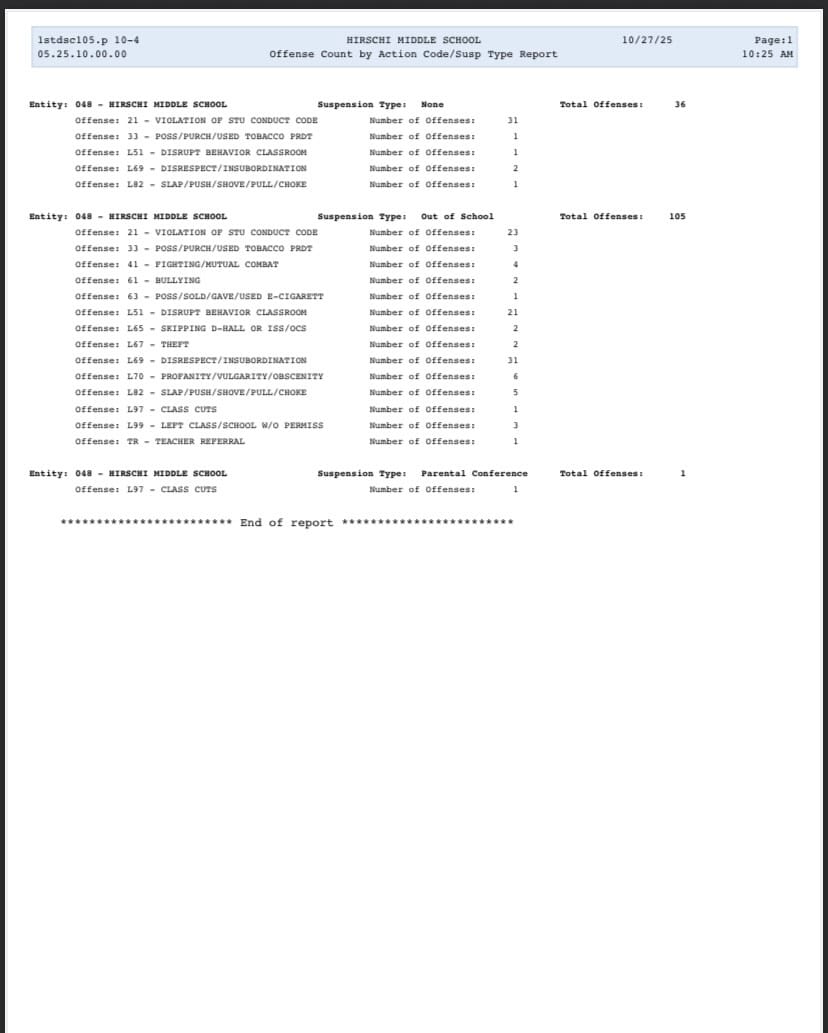
“Unless you have a program that has the same culture everywhere they go, regardless of where they’re at, it doesn’t matter where you place them, they follow the same rules and the same expectations, and that in itself is what the issue is with Third Future,” Fields added. “You can’t have that in public education. You have too many students that have to be serviced for different things.”
While Fields is just one of many teachers and parents in the community that have concerns over Third Future’s leadership style, the only way to know for sure how things will work out is to wait and see. If Craddock sticks to his goal of presenting numbers at Town Hall meetings during the Spring semester and those numbers can reflect growth, perhaps members of the community will feel more at ease. For now, all the community has to go off is the perspective of students, staff, and parents at Hirschi.
“I don’t expect everyone to be perfect, but we do expect growth,” Craddock said. “We’re dealing with people – they have emotions – we know we’re not going to be able to make everyone happy.”
Third Future’s partnership with the school district is set to include Southern Hills and Booker T. Washington beginning in 2026.
***DISCLAIMER: Reanna Gonzalez was very briefly employed by Hirschi Middle School but the information and perspectives shared in this article are not reflective of her time there. The parties involved in this story were not connected to her prior to this article being written. Her perspective in no way plays a role in this article, rather it is intended to reflect the thoughts and concerns of those directly involved.***