As complications with Texas SB 12 continue, it’s already impacted the North Texas community
While some areas have been halted in relation to SB 12 due to a lawsuit, other areas of Texas, including Wichita Falls, have already begun to see its effects in relation to education and diversity.

Texas Senate Bill 12 was authored by State Senator Brandon Creighton (R-Conroe), co-authored by multiple Republican Senators, and sponsored in the House by Representative Jeff Leach. The bill was presented as focusing on strengthening parental rights when it comes to school and healthcare. However, the bill has a more deliberate stance on topics relating to race, gender, and sexuality.
While the bill is primarily aimed at K-12 schools, some Texas universities have also implemented some of its expectations. Texas Tech University Schools are among those, which Creighton serves as the Chancellor of.
Since its beginning, over a year ago, the bill has seen a lot of push back due to its vague wording and some groups stating that its standards around race, gender, and sexuality cross the line of being unconstitutional.
The bill’s description is “Relating to parental rights in public education, to certain public school requirements regarding instruction, diversity, equity, and inclusion duties, and social transitioning, and to student clubs at public schools.”
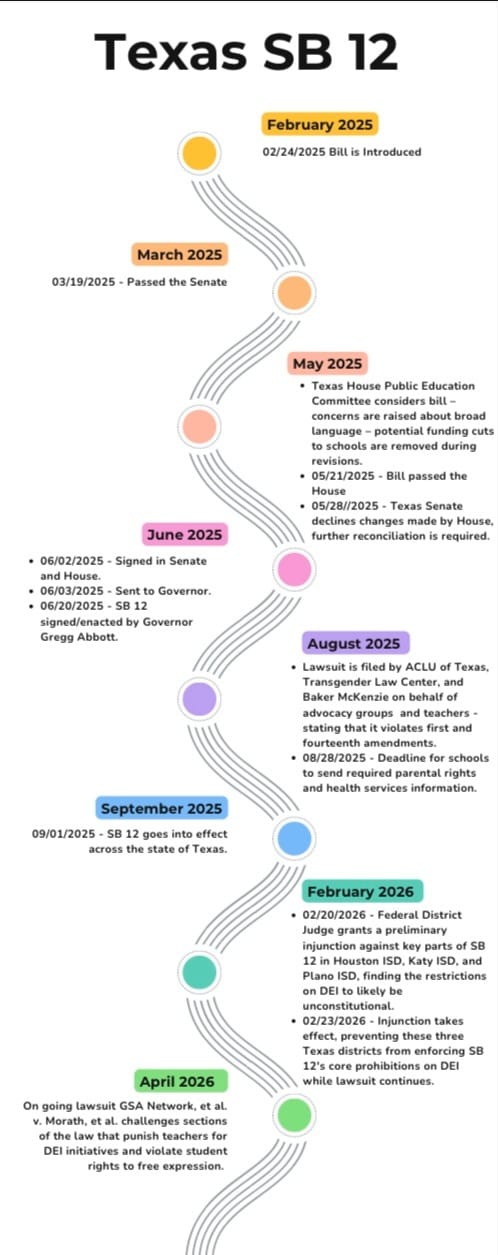
The three independent school districts that are currently omitted from the expectations of SB 12 through injunction are only so because of a current lawsuit. For other schools around Texas, the changes under SB 12 have been in effect for a few months and have already had an impact on those communities. While some Texas residents have voiced praise for the bill giving parents more involvement, others have expressed concern for how the bill will impact the mental, emotional, and physical well-being of the groups they say the bill targets.
As far as parental involvement, the bill details a list of topics that require parental approval before they can take place. According to Section 10 26.004 (b) of the bill, these are as follows:
A parent is entitled access to all written records of a school district concerning the parent ’s child, including:
- Attendance records
- Test scores
- Grades
- Disciplinary records
- Counseling records
- Psychological records
- Applications for admission
- Medical records in accordance with Section 38.0095, including health and immunization information
- Teacher and school counselor evaluations
- Reports of behavioral patterns
- Records relating to assistance provided for learning difficulties, including information collected regarding any intervention strategies used with the child.
Mel is a Reverend at the Wichita Falls Metropolitan Community Church who also serves as the lead for the Wichita Falls Diversity Coalition (WFDC) and Safe Harbor. Mel said at 50 years old, he’s seen a lot of change take shape across Texas — especially being involved in so many nonprofits — and he’s already seen how SB 12 is contributing to those changes.
One of the many focuses of the WFDC is providing safe spaces for members of the LGBTQ+ community. One way they achieve this is by hosting a Pride in the Park event each year. While Mel said he doesn’t believe SB 12 will impact the Pride event, he does believe it will impact the ability the organization has to cater to LGBTQ+ youth. He mentioned that the organization does still work with the Pride organization at MSU Texas. While he is unsure how SB 12 will affect the turnout at the Pride event, he hopes the concerns around the bill will boost the event because there will be a greater need for the sense of community and protection among those that are LGBTQ+.
Specifically, the bill refers to topics around sexuality and gender in Section 28.0043, by stating: “A school district, open-enrollment charter school, or district or charter school employee may not provide or allow a third party to provide instruction, guidance, activities, or programming regarding sexual orientation or gender identity to students enrolled in prekindergarten through 12th grade.”
“We need to talk about the value of diversity — we need to be teaching grown people that empathy is not an enemy. Empathy is a sacred part of being a human being,” Mel said.
Mel added that he also works with the Opal Center, which is where he’s been able to witness the impact SB 12 has already had on members of the LGBTQ+ community. He said it’s had the greatest impact on teens and young adults in their 20s.
While Mel noted that he doesn’t believe SB 12 is all bad, and that he appreciates its stance on giving parents a say in their kids’ education, he believes it creates a dangerous and othering rhetoric around kids that stand out as different. He said he also finds its points that apply to drag performances as “hypocritical” because he’s grown up watching movies with drag performances that didn’t receive the criticism he says is now taking place against people simply being themselves.
Mel believes a lot of the emphasis in SB 12 on casting out certain ideas or perspectives is rooted in religious context. Although Mel is a proud and committed Reverend, he said this mentality worries him because it enforces Christianity, rather than welcomes it along with other religions. He believes this defies what the nation was founded on.
“It’s a measure of just humanity to remember that this country was not founded on a particular understanding of God or human beings or human value even,” Mel said. “We’re diverse and we continue to be diverse, and there’s no amount of legislation that’s going to erase that fact.”
In addition to how SB 12 has impacted marginalized groups of the community, it has also drastically changed the classroom setting for many teachers. Alison Fields, who is a teacher at Southern Hills Elementary in Wichita Falls, said that in the four years she’s been teaching, she’s seen several changes in curriculum, though usually small. She said generally these changes include changes to online curriculum sources or alterations to grammar or lesson structure. However, she noted that the changes were consistent and becoming more noticeable each year. Some of the more notable changes she mentioned involved modification of Greek mythology lessons, due to violent or sexual themes, and a complete removal of lessons about Cesar Chavez.
Fields said that since SB 12 was implemented, the changes she’s noticed seem to have veered away from curriculum and begun to directly impact student health services and support. She mentioned some of the common ways she witnesses this such as the fact that a parent’s signature is required before a school nurse can treat a student or a counselor can see a student. She also noted how teachers are no longer allowed to offer small acts of help through bandages or ointments. Fields said she worries how these strict policies could get in the way of a student receiving immediate vital treatment if necessary, or finding support if they’re experiencing abuse at home. She explained that SB 12 seems to have made teachers more fearful of stepping in under such circumstances.
One of the amendments that SB 12 underwent included its repercussions for teachers Regardless, its initial phrasing has left an impression that several teachers have shared makes them feel powerless to a certain degree. Initially, it says the bill “shall prohibit a district employee, contractor, or volunteer from engaging in diversity, equity, and inclusion duties. School district shall adopt a policy and procedure for the appropriate discipline, including termination, of a district employee or contractor who engages in or assigns to another person diversity, equity, and inclusion duties.” The amendment in Section 28.0022 adds, “This section does not create a private cause of action against a teacher, administrator, or other employee of a school district or open-enrollment charter school. School district or open-enrollment charter school shall adopt a policy and procedure for the appropriate discipline, including termination, of a district or school employee or contractor who engages in or assigns to another person an act prohibited by this section.” This is to say, the bill can not discipline teachers for their associations with such groups or causes outside of school.
“While I understand and agree with the idea of parental consent, in reality, it has created a lot of gray areas,” Fields said.
Fields said she feels conflicted about SB 12. As a parent, she appreciates its efforts to promote parents’ involvement in and awareness of what children are taught. However, as an educator she shared that she’s already begun to see the impacts of the restrictions on DEI focused clubs, staff roles, and the materials available in schools. She said that she believes the way DEI is being interpreted has resulted in programs and curriculum content being removed unfairly. As a result, she said this impacts the support and understanding she can provide to students.
Fields expressed that she’s worried about the long term effects of SB 12 making school a less comfortable environment than it already is — for students and staff. She said she fears that drastic changes to curriculum to exclude events or stories that could be considered DEI will mean students’ understanding of history, current events, and critical thinking skills will be limited. She shared that she’s also concerned that this will result in students with minority backgrounds not feeling seen, being othered, and even being bullied.
“If teachers are limited in discussing topics like prejudice, racism, and sexism, students may not fully understand these issues. Without that understanding, they may lack empathy and awareness, which could lead to more negative behaviors,” Fields said.
Ultimately, Fields believes parents should have a right to be involved in their children’s education, but that the Texas Education Agency and the education system as a whole must ensure students are learning accurate and meaningful content. She said she believes this includes topics that might be uncomfortable for some students but are necessary for proper learning and their understanding of the world. She went on to suggest that parents who want complete control over what their children learn have the option of home schooling or selecting a private or charter school that aligns with their educational expectations.
While Fields said she’s going to do her best to continue to be a caring and attentive teacher that students trust, she’s witnessed how other teachers are more hesitant to form impactful relationships with students for fear of somehow crossing a line established by SB 12. She said Texas Senate Bill 12 has impacted how she envisions her future in education, believing it may become more difficult to be the kind of teacher she wants to be.
Even Mel has expressed concern over SB 12’s control on education. He claimed SB 12 makes broad determinations about students at all levels and fails to consider that different grade levels have different needs. He noted that he believes some of the changes under the bill will increase bullying and create a push toward homogeneity. He said he feels that parents that are uncomfortable with topics that SB 12 would consider DEI should find ways around such lessons, like how sex-ed courses are to be handled under the bill. Specifically, SB 12 states that Sex-Ed courses should be handled as follows: “Before a student may be provided with human sexuality instruction, a school district must obtain the written consent of the student ’s parent. A request for written consent under this subsection: may not be included with any other notification or request for written consent provided to the parent, other than the notice provided under Subsection (i); and must be provided to the parent not later than the 14th day before the date on which the human sexuality instruction begins.”
Mel explained that he believes if steering away from essential learning points for the sake of comfort of a few becomes the standard, it will result in the United States losing credibility with the rest of the world. He added that this will be reflected in news being more geared toward entertainment than informing and politicians abandoning morals and concerns for the well being of constituents for the pursuit of power.
“I need our politicians and our legislators to make decisions to not sacrifice the lives of the few for the votes of the many,” Mel said.
While Dark Roast Report attempted multiple times to communicate with Senator Creighton to get his perspective on the bill, he did not respond. However, he did share this post on X (formerly Twitter) on May 31, 2025 that gives some insight to his thoughts on the matter:
“The Texas Senate just passed SB 12 — the strongest Education Parental Bill of Rights in America. Texas parents now have a guaranteed seat at the table with our schools and their voice now have greater protections in law. Final approval is still needed in the house, but this is a National model in the making.”
For those who don’t agree with the stance Texas Senate Bill 12 takes on education and diversity, Mel suggests supporting and getting involved with getting involved in organizations focused on inclusion, diversity, and a broader scope of informing.