Library Card Sign-up month promotes irreplaceable resources
Library Card Sign-up Month, which takes place every September, began in as an initiative to get more children to read. It grew from there, spanning across all public libraries and catering to all ages, while promoting libraries amidst society's reliance on technology.

Library Card Sign-up Month, which takes place every September, began in 1987 as an initiative to get more children to read. It grew from there, spanning across all public libraries and catering to all ages.
Today, the month-long event serves a much broader purpose than just encouraging reading. In the modern world, Library Card Sign-up Month provides the community with valuable resources, and benefits local libraries just as much. The event is particularly impactful for small town libraries, as it can rally the whole community to participate.
Amy Ryker, the Library Director at Duncan Public Library said this year’s Library Card Sign-up month theme is “A Library Card Hits All the Right Notes.” In relation, she mentioned that this year’s honorary Chair is Laufey, who is an Icelandic singer and author of the children’s book, “Mei Mei the Bunny.”
“We understand that it is parents who have to bring the children in, so they have to care about it, too. So, we tend to gear our initiative toward EVERYONE in the past couple of years,” Ryker said.
Public libraries are valuable resources that serve a purpose for the whole community. They provide a free, safe, quiet space for people to read, work on projects, or simply sit. They have items for both kids and adults. They offer free classes focused on niche topics, technology use, and self-sustainability. They also have media libraries, item libraries, and access to computers.
Even digital resources are abundant at local libraries as Ryker listed apps like Libby, Hoopla, Kanopy, Mango Languages, Universal Class, Chilton Library, as examples. Ryker also noted that there is still a literacy crisis in America and that libraries are still a part of helping improve on that. In a room filled with pages of words, it’s no surprise that there’s an answer for everyone.
In addition to serving the community, when people get library cards, they help out their local library. The number of library cards and active users at a library location have a significant impact on its success, resources, and funding. As society moves in a direction that’s more reliant on technology and less social, there’s more threats against the future of public libraries, though Ryker noted that technology poses much more costly access to information than local libraries. Without proof that people are actively using libraries, they could cease to exist which would eliminate a vital community resource that technology could simply never replace.
“When you get a library card, you not only add to the count of people in the community using the library, but you are given the opportunity to add to the counts of checkouts and patron activity that we use to illustrate demand and justify funding through our city and state,” Ryker said.
Ryker admitted that in recent years, Library Card Sign-up Month hasn't resulted in the numbers they aim for. She pointed out that there are generally trends at different times of the year in which numbers are lower. Holding the event in September is intended to compliment the school year and promote the cards when kids are still eager to learn and then sustain the incentive to come back throughout the year. For the same reason, libraries generally hold events and contests and promote reading and new books.
“Honestly, we have quite a boost in summer because people are coming in for summer reading, and sometimes a boost in August because school is starting, then September tapers off a little. The goal is to keep that number high,” Ryker said.
Although technology like AI provides more convenient access to information, it comes with paywalls and censorship. Ryker views this point as further incentive to get a library card, especially because libraries offer so many online sources for free. She said that as budgets are being cut and the cost of living is rising, libraries are the only feasible option for resources and information for some people. Further, she referenced movements across the nation to eliminate free and equitable access to information and books which local libraries actively negate.
Ryker clarified that the library does not monitor the information of library card holders, but through survey data, it appears that the age group most actively utilizing libraries are millennial parents. She said this gives her hope because it’s a generation that grew up loving libraries teaching the next generation to do the same.
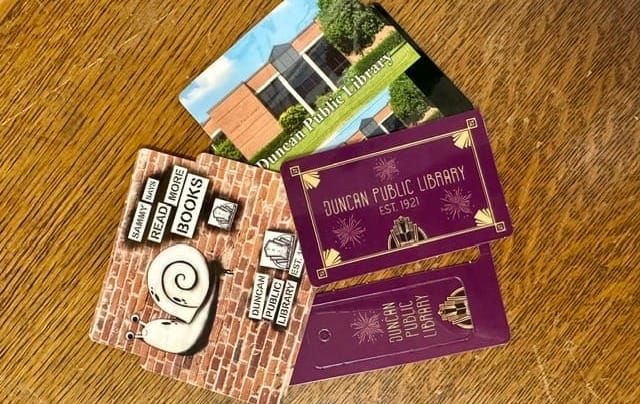
As accessible as using a library card is, getting one is just as easy. Ryker said library cards through the Duncan Public Library are free to residents of Stephens County. That said, residents from outside counties only have to pay a one-time fee of $25 per family. To apply, applicants must have a photo ID, proof of address, and must fill out a brief application. Ryker said once someone receives a library card, they can check out up to five items their first time and then up to 30 items anytime after that.
There are several ways community members can help their local library, especially in small towns. Obviously, getting a library card is the best place to start. From there, Ryker said people can join the Friends of the Duncan Public Library fundraising group, which only costs $10 a year. Several communities with public libraries have a Friends of the Library group. Residents can also purchase books from the year-round book sale room. Other than that, Ryker said the biggest way to help is to spread the word about what local libraries offer, through word of mouth, social media, and to local legislators and representatives.
Library Card Sign-up Month takes place through the month of September at public libraries and school libraries across the U.S. Oftentimes, local libraries will hold giveaways and contests to promote the event that are unique to each location. To check out what initiatives are being held at nearby libraries, visit their websites or social media pages. To learn more about the Library Card Sign-up Month, check out the American Library Association.